FFI International Group

FFI International Group
"Realeconomik Leadership"

NO EXCUSES - GET IT DONE

Featured post

#BIG #PLAYERS SEE #OIL AT $200 By 2022-End

  OILPRICE.COM Top Oil Traders See Oil Topping $200 By End-2022 By  Irina Slav  - Mar 24, 2022, A number of big oil traders now predict crud...

Search This Blog

Showing posts with label Singapore. Show all posts

Monday, 29 February 2016

HSBC: YIKES - Arab States Going Broke!

How many businesses can withstand a drop in revenues of 50% or more and expect to survive? Few,  if any! With oil prices being down by that percentage, expect many of the resource based countries to start defaulting on their debt and thereby crashing the global banking system along with the stock markets. It will cascade!

It was all a house of cards built on an exuberant credit bonanza fueled by unprecedented low loan rates that was doomed from the start. Now here comes the payback - and it won't be pretty.

All things revert to the mean - that's the first  law of common sense, just ask Soros!


Arab States Face $94 Billion Debt Crunch on Oil Slump, HSBC Says


Gulf Cooperation Council countries may struggle to refinance $94 billion of debt in the next two years as the region faces slowing growth, rising rates and rating downgrades, according to HSBC Holdings Plc.

Oil-rich GCC states have to refinance $52 billion of bonds and $42 billion of syndicated loans, mostly in the United Arab Emirates and Qatar, HSBC said in an e-mailed report. The countries also face a fiscal and current account deficit of $395 billion over the period, it said.

Expectations that these funding gaps "will be part financed through the sale of sovereign U.S. dollar debt will complicate efforts to refinance existing paper that matures over 2016 and 2017," Simon Williams, HSBC’s chief economist for the Middle East, said in the report. "With the Gulf acting as a single credit market, the refinancing challenge will likely be much more broadly felt" and "compounded by tightening regional liquidity, rising rates and recent downgrades," he said.

READ MORE

The Game Changed in Venezuela  
People continue to be arrested merely for protesting, and a long established local Human Rights NGO makes an urgent plea for an investigation into widespread reports of torture of detainees. There are now dozens of serious human right abuses: National Guardsmen shooting tear gas canisters directly into residential buildings. We have videos of soldiers shooting civilians on the street.


Washington warns top banks to stay away from Russian bonds   

Russia’s dollar-denominated 2023 bond now has a yield of 4.53 percent, sliding from 4.9 percent in September 2013 when Moscow raised $7 billion, data from the Financial Times showed.
According to the WSJ, some bank officials, including those at Citigroup, said they won’t participate. Goldman Sachs and J.P. Morgan Chase say they are still weighing their options.


Moody's Downgrades Brazil Sovereign Rating 

 Itau Unibanco Holding SA, Banco do Brasil SA and Banco Bradesco SA were among more than two dozen financial firms in Brazil that had credit ratings cut by Moody’s Investors Service after it stripped the nation of an investment grade this week.


Ratings affected in the latest shakeup included baseline credit assessments and bank deposit and debt ratings, New York-based Moody’s said Thursday in a statement.
While the moves were prompted by the change in the sovereign rating, Brazilian banks’ creditworthiness “may also face downward pressure if Brazil’s very challenging operating environment results in a deterioration of their financial fundamentals, particularly profitability, asset quality and capitalization,” Moody’s said.
Brazil was cut two steps below investment grade, to Ba2, with a negative outlook, a sign the rating might go lower. The downgrade came one week after Standard & Poor’s reduced Brazil’s rating to BB, also two steps below investment grade with a negative outlook. The moves reflect Brazil’s worst recession in more than a century, a nationwide corruption scandal and declining demand from China for Brazilian commodities.

Why Singapore's Economy Is Heading For An Iceland-Style Meltdown


It has been just five years since the Global Financial Crisis, and the world – in brazen defiance of the lessons of 2008 – is already back to blowing massive bubbles and naively praising the countries that are benefiting from these “fool’s gold” economic booms. The Southeast Asian island nation of Singapore is currently inflating one of the most egregious examples of these post-2009 bubbles, and is displaying parallels to Iceland’s bubble that are causing me to believe that its boom will end in a similar (but not necessarily identical) manner.

READ MORE

http://www.forbes.com/sites/jessecolombo/2014/01/13/why-singapores-economy-is-heading-for-an-iceland-style-meltdown/#346ffdb113cc


Wednesday, 24 February 2016

Singapore's Financial System Melting Fast


Singapore Lawyers Warn of 1998-Like Pain as Debt Defaults Spread  


Rajah & Tann Singapore LLP, Southeast Asia’s largest law firm, reckons the region’s rising bond defaults will inflict as much pain on creditors as the financial crises of 2008 and 1998.
As distress spreads from shipping to mining and retail to construction industries, the law firm said in an interview that recovery rates will be similar to those seen in the global credit meltdown and Asian financial crisis. Secured creditors recover only less than 33 cents on the dollar from insolvencies in East and South Asia, compared with more than 80 cents in the U.S., according to World Bank studies. Rival law firm Hogan Lovells US LLP said in an interview that regional banks will likely boost sales of bad loans in coming months.
“The trough in the mining cycle seems to be continuing and some say it will be a while more before any significant recovery is expected,” said Sim Kwan Kiat, Rajah & Tann’s head of restructuring and insolvency based in Singapore. “From experience, the lower end of the spectrum for recovery rates this time round in 2016 is unlikely to be much different from those in 2008 or 1997-98.”


The potential of these dislocations to derail the UK’s economic recovery has not been lost on our policymakers. The Bank of England’s Monetary Policy Committee has comprehensively surrendered the idea of finally raising interest rates: its one member who had been voting in favour joined the more pessimistic majority earlier this month. The Chancellor, meanwhile, has been at pains in recent speeches to warn of the “cocktail of risks” facing the British economy. There seems little doubt, in other words, that the sudden acceleration of uncertainty on global financial markets is serious. But why is it happening – and what does it mean?


Earlier this week, Baghdad extended an offer to pay the salaries of the KRG’s public employees in return for a halting of unilateral oil exports by the Kurds. Both sides need this deal. The KRG is struggling to pay salaries, and protests are mounting—threatening the stability of what was not long ago the only peaceful and secure place in all of Iraq.


Overall, imports by states in the Middle East increased by 61%; imports by European states decreased by 41% over the same period. Britain sold more weapons to Saudi Arabia than to any other country. Saudi Arabia is also the biggest US arms market and buys more American arms than British, the report shows.

Panic Below The Surface: 


"Banks Are Selling Energy Loans At Cents On The Dollar  

One week ago, when we commented on the latest weekly update from Credit Suisse's very well hooked-in energy analyst James Wicklund, one particular phrase stuck out when looking at the upcoming contraction of Oil and Gas liquidity: "while your borrowing base might be upheld, there will be minimum liquidity requirements before capital can be accessed. It is hitting the OFS sector as well. As one banker put it, "we are looking to save ourselves now."


Wednesday, 19 August 2015

Rock Star China Analyst Paints Bleak Picture, & More


There are China analysts, and then there is Charlene Chu.
She has been called a rock star of Chinese-debt analysis. Money managers the world over pay tens of thousands of dollars for access to her research at her new firm Autonomous Research. Her reports are rarely leaked, and she rarely gives interviews.

Business Insider got a glimpse at a massive report she wrote at the end of July.

This was when everyone was freaking out about the precipitous fall of China's stock markets, and it predates the Chinese authorities' decision to devalue the yuan.

Her base case in the report was for Chinese authorities to maintain stability of the equity market and forestall contagion.There is also a doomsday scenario, however, in which there is contagion to other domestic and international markets, large capital outflows, and an acceleration of problems associated with financial-sector weakness and corporate indebtedness.

The report said: "This in turn would likely lead to a significant pullback in credit, putting the brakes on GDP growth and bringing an end to China's decades of stellar economic growth. At that point, social and political stability — the critical wild cards in this equation — could come under question."

This is what doom looks like


Greenspan warns about bond-market bubble


: Former Federal Reserve Chairman Alan Greenspan is sounding the alarm about a bubble that he believes is forming in the bond market.
In two television interviews in recent days, Greenspan said interest rates could shoot higher and derail the economy when the bubble bursts.
The former Fed chairman says the current situation in the bond market is comparable to what happens in the stock market during an equity bubble.
Noting that stock-market bubbles are typically characterized by extreme price-to-earnings ratios, Greenspan said extremely low yields are telling a similar tale for bonds.
“If you turn the bond market around and you look at the price of bonds relative to the interest received by those bonds, that looks very much like the usual spread which would concern us if it were equities, and we should be concerned,” Greenspan said in an interview with Fox Business Network.


Growth in OPEC’s biggest exporter will slow to 2.8 percent this year and 2.4 percent in 2016 after oil prices slumped, the Washington-based IMF said in a statement on Monday. If spending isn’t curbed, its fiscal deficit would be “very large” this year and over the medium term, it added.


“Moody’s isn’t the only one predicting that growth will be slow to rebound,” said Ari Santos, a trader at Sao Paulo-based brokerage H.Commcor. “Looking forward, we’ll have a stagnant economy, with no growth and no outlook to grow.”


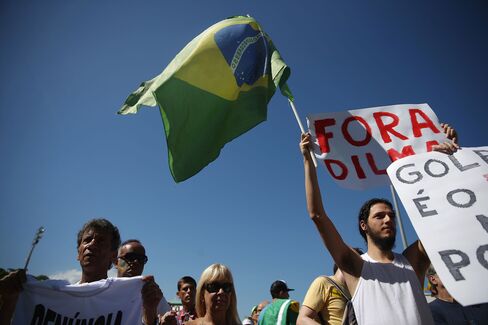
Protesters calling for the impeachment of President Dilma Rousseff march along Copacabana beach on Aug. 16, 2015.
In the midst of its deepest economic and political crisis in a generation, Brazil is contending with a business climate so punishing that major projects across numerous sectors are being frozen or shrunk, while small businesses slash prices and shift focus.


Singapore-based wealth managers, already under pressure from a global move towards tax information sharing, face a more immediate threat as Asian countries including Indonesia and India look to chase undeclared money in the low-tax city state. A global crackdown on tax evasion launched during the 2008 financial crisis has already forced Switzerland and other European offshore hubs to surrender their prized bank secrecy.


The combined deficit of private sector DB schemes in the UK

 now stands at around £900 billion, up from £250 billion

 since the start of the millennium, despite companies pouring

 in £500 billion towards pension saving over that time.

 According to Hymans Robertson, the stark figures highlight

 that for too long pension schemes have been taking too 

much risks


Learning Success: 


APPLY Tips From The Best


Larry Page,  Google – 


Image result for larry pageLarry Page is another example of a businessperson who can persevere any challenge. Larry and his company have faced much criticism and received ample praise over the years for his company’s actions. But in the midst of the storm, he has never let what others think sway him from pursuing the course for his company that he considers the best.


Top Weekly Ideas and Insights


An Inconvenient Truth


"Battle For Oil" 


What Happens When Political Interests Get Desperate?


EXISTENTIAL REALITY 


"Coming To The End Of Oil Age"

 - Looking Beyond The Brink -


Most All-timePopular Posts

DREAM BIG, ACHIEVE SMART