FFI International Group

FFI International Group
"Realeconomik Leadership"

NO EXCUSES - GET IT DONE

Featured post

#BIG #PLAYERS SEE #OIL AT $200 By 2022-End

  OILPRICE.COM Top Oil Traders See Oil Topping $200 By End-2022 By  Irina Slav  - Mar 24, 2022, A number of big oil traders now predict crud...

Search This Blog

Showing posts with label globalcrash. Show all posts

Tuesday, 3 June 2014

Head for the Hills - Cash Flow #Valuations Now Absurd

Gentlemen! Can you believe these charts?

Investing 

Using 


Price-to

-Cashflow 

Ratio and

 Cashflow 

Yield


 (Backtests 1951 to 2013)
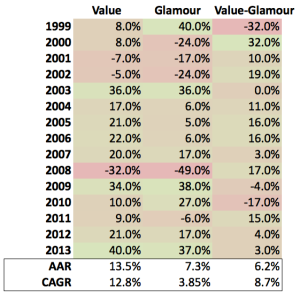


VW PCF Returns 1999 to 2013The price-to-cashflow ratio (PCF) is a popular metric among value investors. Many believe that using cashflow, rather than accounting earnings, delivers a truer picture of a company’s business performance, which in turn leads to better investment performance.


Set out below are the results of two Fama and French backtests of the cashflow yield (the inverse of the PCF ratio) data from 1951 to 2013. As at December 2013, there were 2,526 firms in the sample. The value decile contained the 269 stocks with the highest earnings yield, and the glamour decile contained the 311 stocks with the lowest earnings yield. The average size of the glamour stocks is $4.74 billion and the value stocks $4.80 billion. (Note that the average is heavily skewed up by the biggest companies. For context, the 2,526th company has a market capitalization today of $272 million, which is much smaller than the average, but still investable for most investors). Stocks with negative cashflow were excluded. Portfolios are formed on June 30 and rebalanced annually.


Annual and Compound Returns (Portfolio Constituents Weighted by Market Capitalization)


In this backtest, the two portfolios are weighted by market capitalization, which means that bigger firms contribute more to the performance of the portfolio, and smaller firms contribute less. Here we can see that the value decile has comprehensively outperformed the glamour decile, returning 16.7 percent compound (18.6 percent in the average year) over the full period versus 9.3 percent for the glamour decile (11.5 percent in the average year). - 


 Read More


VW PCF Returns 1951 to 2013 v2


Remember an Old Lesson 


Platinum Advice:

The secret of successful investing - then the rest is up to you. Oh yeah, and never marry the markets.

"Cash Flow, Cash Flow, Cash Flow"

That stated, these markets are way over priced as the cash flow values make no sense. Looks like 2000 all over again if we run out of those bigger fools.

Platinum Wealth Partners
June 3,  2014

Friday, 11 April 2014

Sallie Krawcheck: BANKING DOOMED OR BORING?

State of Banking: Not Awful, Not Great, Just 'Meh'


By Sallie Krawcheck


The outlook for my (former) industry, banking, is ... "meh."
Now, that is a word that one rarely hears about this industry. Instead the results are typically described as either “awful!” or “great!” And that’s because the Wall Street firms and big banks are volatile: their results are driven in good part by the markets, which are themselves volatile, and because the banks’ continuing financial leverage amplifies that volatility. So, at any point in time, the industry appears to be in great shape or in poor shape, depending on the external environment. For years and years, industry commentators (and participants) have confused the impact of market movements with the outlook for underlying growth and bank safety.
Looking beyond the cycle, then, how to grow? Many firms turned to cost cutting during their leaner years, but, by its nature, this has limits.
Then, as the cycle has turned, many have cited innovation as a future driver of growth. This is despite the fact that most of what was hailed as product innovation in the past was, in hindsight, simply increases in product risk, wrapped in complexity. Recall CDO-squareds; it and its brethren were hailed as innovations in their day. But what these “innovations” earned in good times was lost, plus much, much more, in down markets.
And if true innovation was really tough for the industry to achieve before, it becomes much more difficult with the layering of internal and regulatory “processes and procedures” at the banks in the aftermath of the crisis. Processes and bureaucracy are the arch enemies of innovation.
So is the future of the industry simply to ride out the cycles?
Perhaps. But the optimist in me believes there is another way forward for the banks. And that is to turn their (and capitalism’s) historic “shareholder first” orientation into “customer first.”

Tuesday, 8 April 2014

More Rumblings of Economic Dangers

We Are Nearer Economic Collapse Than Most People Think , Or In The Case Of Governments, Admits To.

We are nearer economic collapse than most people think, or in the case of governments, admits to. The Eurozone is done but still they cling on making noises about recovery and a return to financial normality. In the US, the lies of the federal reserve and the ever rising debt ceiling are combining to bring an economic disaster that will make the ‘credit crunch’ look like a kids party.

A Financial Typhoon Warning For Hong Kong

…Even HSBC’s house broker, Credit Suisse, appears alarmed at the storm clouds gathering over China and recently cut its recommendation on the bank’s shares from “buy” to “sell”, warning about the potential unwind of the dollar-renminbi “carry” trade.

Although neither HSBC nor Standard Chartered are likely to have lent much directly to mainland Chinese businesses the issue is more a question of whether they have lent to financial institutions that have lent to businesses that could be hit hard in the event of a severe downturn.

Victor Wang at Credit Suisse points out that it is almost impossible to distinguish “real” trade financing from “carry trade”, but estimates that the speculative trading could be worth at least $200bn (£120.5bn).

Hong Kong’s financial supervisor is widely seen as one of the world’s best macro prudential regulators, but Innes-Ker questions whether even the super-savvy Hong Kong Monetary Authority (HKMA) can save the territory from the crisis that could be unleashed if China’s credit bubble were to burst in an uncontrollable fashion.

“The biggest risk is that you’ve got a financial sector that is several times the size of the economy and you have to question whether the authority’s ability to step in is relatively constrained,” he says.

Others are more sanguine about the risks.

"pictures talk better than words"
“The Chinese economy is so controlled they will be able to manage any issues. The idea that the authorities don’t see these problems is ridiculous. If something is happening it is because they tolerate it,” says one Hong-Kong based banker.

Comments:

This all ties into the market warnings set out by Investors' Insights this morning. 

With the world's biggest economies experiencing  huge troubles, destiny's hand slams down  hard outcomes. What if there is no higher ground? What if?

Platinum Wealth Advisors
April 8, 2014 - 7:00 am, EST

Most All-timePopular Posts

DREAM BIG, ACHIEVE SMART