FFI International Group

FFI International Group
"Realeconomik Leadership"

NO EXCUSES - GET IT DONE

Featured post

#BIG #PLAYERS SEE #OIL AT $200 By 2022-End

  OILPRICE.COM Top Oil Traders See Oil Topping $200 By End-2022 By  Irina Slav  - Mar 24, 2022, A number of big oil traders now predict crud...

Search This Blog

Showing posts with label trends. Show all posts

Tuesday, 1 September 2015

Good Or Bad News? As US Oil Production Peaks Again, & More


US Oil Production Nears Previous Peak


The EIA’s Monthly Energy Review came out a couple of days ago. The data is in thousand barrels per day and the last data point is July 2015.


US consumption of total liquids, or as the EIA calls it, petroleum products supplied, reached 20,000,000 barrels per day for the first time since February of 2008.
Something I never noticed before, consumption started to drop in January 2008, seven months before the price, along with world production, started to drop in August 2008. This had to be a price driven decline. Could the current June and July increase in consumption be price driven also?


The Fed won’t raise rates until the world economy looks healthier, but the world economy is actually OK. Even China is OK. (Apple said that the China consumer is pretty healthy). World economic numbers will look much better in 2016, and central banks outside the U.S. will begin raising rates … and that will finally give the Fed the cover it needs to raise.


The seriousness of last week’s shocking action in the market is shown by the volatility index, which posted its second highest reading since its inception in 1990. This is comparable to the great crash of 2008/9.


Many migrants are crossing from Turkey to Greece, Macedonia and Serbia before entering Hungary and then moving on to wealthier countries in northern Europe. (There is an important legal distinction between a migrant who has fled his or her country and a refugee seeking asylum.) The conditions in which they would wait out approval of their applications in Germany and Sweden are better than in places such as Hungary or Greece.


Both moves—the government pulling back from its market bailout and the currency devaluation—stem from the same ominous problem: China’s leaders are scrambling to find the money to keep its economy running. To understand the broader forces that led to this predicament, here’s a chart-based explainer tracing its origins.


Fermi's Paradox, climate change, capitalism, and collapse are some of the subjects discussed in this feature length documentary on the environmental crisis. Interviewees include Bill McKibben, Gary Snyder, Derrick Jensen, Peter D. Ward, Jill Stein, Bill Patzert, Guy McPherson and other top academics, scientists and public intellectuals.


Why So Much Oil Price Volatility? Blame The Speculators


Oil prices crashed last week only to rebound at lightning speed. On August 28, oil prices surged 10 percent, the largest one-day gain in seven years. So, what happens next for oil prices?
On the face of it, the crash and massive rebound makes little sense, with many oil market analysts undoubtedly left shaking their heads.
But there is a logic to what unfolded, just not the logic of the physical market for crude. Oil prices, as if we needed a reminder, are largely driven by speculation. Why else would oil prices plummet by five percent, then spike by 10 percent just a few days later? Not much changed in terms of actual supply and demand of oil in the intervening days.
Sure, Royal Dutch Shell declared force majeure on some oil shipments from Nigeria, as two pipelines had to be shut down. That could interrupt some oil supplies. But other than that, the physical market for crude didn’t see a whole lot of change in just a few days’ time.


A Passing Thought...

Image result for cat on a hot tin roof

Thursday, 27 August 2015

Financial Advice Fails - As Everybody Becomes Poorer, & More #News


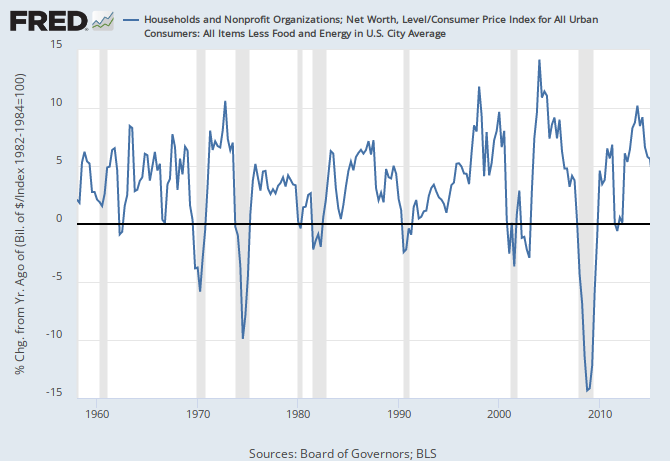
Real Household Net Worth:


 Look Out Below?


In my last post I pointed out that over the last half century, every time the year-over-year change in Real Household Net Worth went negative (real household wealth decreased), a recession had either started, or was about to.  (One bare exception: a tiny decline in Q4 2011, which looks rather like turbulence following The Big Whatever.) Throughout, click for source. - 


The problem: we don’t see this quarterly number until three+ months after the end of a quarter, when the Fed releases its Z.1 report for the the preceding quarter. The Q2 2015 report is due September 18.

But right now we might be able to roughly predict what we’re going to see four+ months from now, in the report on our current quarter, Q3, which ends September 30. We’re a bit over a month from the end the quarter, and we have some numbers to hand.

The U.S. equity markets are down roughly 7% year-over-year


South Africa's economy contracts, risk of recession grows


PRETORIA (Reuters) - South Africa's economy shrank for the first time in more than a year during the second quarter of 2015, raising the risk that labour disputes and slowing Chinese demand for commodities could push it towards recession.
The economic strain will inhibit the central bank from raising rates further to protect a weak currency and target inflation, while also torpedoing government efforts to keep deficits in check and protect its credit ratings.


Afghan migrants arrive on the Greek island of Kos after crossing from Turkey to Greece

A record 107,500 migrants crossed the EU borders last month to outstrip the previous monthly record in June of 70,000. During the first seven months there were nearly 340,000 migrants, up from 123,500 last year,


A Police officer secures on December 16,
if you bring intolerant people into your country this is what can happen


Not only how we deal with the world and make sense of it, or interact with each other, but also how we look at ourselves and understand our own nature, existence, and responsibilities. 
This is the IT version of my book The Great Field (available in Kindle books).


$2.1 Trillion Erased From U.S.Stocks In Six Days


The enormous losses reflect the deep fears gripping markets about how the world economy will fare amid a deepening economic slowdown in China.

The Dow, S&P 500 and Nasdaq have all tumbled into correction territory, their first such 10% decline from a recent high since 2011.
The S&P 500 -- the best barometer for the biggest U.S. companies -- has lost trillions of market value in the six-day selloff through Tuesday, according to S&P Dow Jones Indices.
To put those losses into perspective, that's roughly equal to the combined market value of these corporate titans put together:
 Apple (AAPL, Tech30), Google(GOOGL, Tech30), Berkshire Hathaway (BRKA), ExxonMobil (XOM), Facebook (FB, Tech30), Walmart(WMT) and 21st Century Fox (FOXA).


Learning Success: 

APPLY Tips From The Best


Image result for sir richard bransonSir Richard Branson, Virgin Group – Anyone who owns more than 400 companies and is worth billions of dollars is clearly doing many things right. I admire Richard Branson’s tenacity, and I admire his personal brand


Image result for surrealism art

Tuesday, 23 July 2013

The Jim Rogers Blog : I would rather be a Creditor than Debtor

The Jim Rogers Blog : I would rather be a Creditor than Debtor (read more)

Lets see if we can make sense of this. Now let's say China holds 1trillion in 10 year bonds and decides to cash or redeem their whole position. What could possibly happen? The Fed wires a one trillion freshly printed electronic dollars to China and takes back the bonds. So instead of holding an IOU due in ten years it now holds an IUO that is due on demand - albeit it is less less than 10% of  US's GDP or in other words all the goods and services output of the US economy for one month.Not much by some measures.

Anyway, now if China decides to convert these dollars immediately to other currencies it actually shoots itself in the foot because by depressing the US dollar they make their exports substantially more expensive to American consumers. Demand for Chinese goods would collapse in the US, that could shut down China's domestic manufacturing causing massive unemployment, and in turn social unrest followed by political change. Somehow it is hard to find a winner in such drama and both sides are thus inter-dependent - strange bedfellows indeed! .

There is a lesson - the best credit terms maybe negotiated by the creditor's biggest debtor - so borrow a lot! But somehow, Ben Franklin and Shakespeare's  wisdom also seems to ring true: neither a borrower nor lender be...

PLATINUM WEALTH PARTNERS
July 22,2013

Or, just tell them to go fly a kite


In the end, this a funny money game where the on-going idea is to keep the process going, regardless of the final outcomes. The outcome is the same as anyone playing musical chairs - when the music stops someone gets left holding the bag. This is obvious as when resources are depleted money in  all forms won't buy much.

Dr Peter G Kinesa
July 22 ,2013   

Sunday, 7 July 2013

The Paul Krugman Blog - Rationality of the Euro

The Paul Krugman Blog - Rationality of the Euro


These comments reflect more on economics and thought-process rather than  markets, however that is what defines the markets when all is said and done.

Britain was certainly on the right track when it decided not to participate in the European experiment. And it remains shocking that Poland is seeking membership in this club, given the mess and clear failure of this project. What is it about Polish people? There is something that we just do not understand. All we can say, is that too often we give up long-term advantages, in order to remedy a short-term problem.

Why did the Brits decide not to join the club - by gosh, as Paul sarcastically notes in his New York tone, they did some "analysis." No one else apparently does? This point, in itself, raises some fascinating considerations when in comes to expressions such as: "they did their homework," "paralysis through analysis" analysed to death" and so on, and so forth. In fact, just writing about it makes one wonder and come to believe that analysis is much more perpetual in motion than stoic; as new ideas, devices, facts and knowledge is brought to the awareness of our cognitive processes. Particularly, for complex situations where the deterministic and subjective variables are always in a dynamic state of change, with the possibility of even  two opposites co-existing as truths at the same or different times. Go figure - the movie never ends !

So you see there is enough material here to write at least ten, five hundred page, books about the analysis of analysis. What is the right amount? the right tools? the right perspective? Or how about  analyzing the initial diagnostics and its tools - if its wrong, then so should be the supporting analysis. Then, there are the assumptions and we can assume that most people have different ones - or can we? The point being, do we ever really know if we are doing the most relevant  diagnosis, analysis and evaluation of goal, facts and constraints leading to the optimal solution for a moment or forever? I have a funny feeling that such knowledge is impossible to attain, except for those who command the arrogance to think otherwise.Why? Because they know, they know everything. 

In the end, this is a "very serious" topic and process, as it defines the fate of individuals, economies, businesses and our species in so many other ways. The case of Britain, supposedly doing the right analysis once, contrasts with years of bad analysis, that saw their Empire rise and fall, from being a political, economic and military powerhouse, to what it is today, and the tomorrows to come. Should we blame it on the analysis?

 Probably, but you may never know for sure!

First Financial Insights 
July 6, 2012


New Yorkers, eh!


ANALYZE THIS BUDDY !


Friday, 5 July 2013

The Dr Peter G Kinesa Blog : ALL ECONOMISTS ARE WRONG - DEAD WRONG:

The Dr Peter G Kinesa Blog : ALL ECONOMISTS ARE WRONG - DEAD WRONG: Captain, My Captain... ALL  ECONOMISTS ARE WRONG – DEAD WRONG! Why we are in this mess: Where did it all begin? Why? ..

Good  time to do a little report and see if there is any evidence that would suggest that Economists are right, and perhaps this conclusion is wrong. Let's see there's Europe, Cyprus, Egypt, Brazil, China, Japan, Greece, and, and, and...

Then of course there's the Fed and the interest rate trap ready to launch us into an asset deflation spiral.  As well as, overpopulation, unbridled growth, biosphere devastation and  exponential resource exhaustion. Hmm. Not much has changed, so....

ALL ECONOMISTS ARE STILL WRONG!

First Financial Insights
July 5, 2013 


Not that way- your other RIGHT!


Thursday, 4 July 2013

The Dr Peter G Kinesa Blog : Human Longevity OR Unbridled Growth??

The Dr Peter G Kinesa Blog : Human Longevity OR Unbridled Growth??: WHAT IS OUR GOAL: HUMAN LONGEVITY OR UNBRIDLED GROWTH? 


Stars of what we are...bringing them back into our arms -

Every now and then it is a good idea to return to prior article and look at it with a older set of eyes to discover if your thoughts and ideas have been changed, modified or turned upside down in some strange way. In this case, very little has changed and there is a strong belief that to have a shot at the universe -  the orientation of humanity's goals must be towards its longevity; not just the absurdity of growth for the sake of growth.

Again, the mathematics speaks in a way that words cannot convey, insofar as the algebra of population and resources can define our visitig rights on this planet. Obviously, the lower the population levels, the greater the time we should have as a species, with all other things remaining equal. Then! And only then, could we come to know what is unknown, a path less chosen and yet to be discovered.


Why not? For that is what makes all the difference.


First Financial Insights  

July 4, 2013


Moving hearts is like trying to catch a star - bringing their minds into its heart; back where it belongs...


Tuesday, 2 July 2013

The Marc Faber Blog: Low Rates FREEZE markets - Mr. Bernanke is most likely to retire

The Marc Faber Blog: Low Rates FREEZE markets - Mr. Bernanke is most likely to retire and unlimited QEs forever will continue

There is no doubt that Central Banks painted themselves into a corner - they have made it impossible to raise interest rates, regardless of inflation. Why? Because if they do, it will cause an unprecedented deflation in asset prices and bring consumer spending to its knees, as disposable income is siphoned away to service debt service costs that could double or worse. It would cripple consumer demand and confidence, in a horrifying way with these double knock-out financial blows, triggering a deep prolonged depression. Moreover, obliterating the balance sheets and capital boxes of  the world's biggest commercial and investment Banks, with the mere stroke of a pen.

What this also means is that governments will do all they can do to manipulate inflation numbers to fool consumers, investors and savers. Time will tell if this form of quiet debasement, confiscation and taxation will work. Probably, because all Central Banks are moving in a similar co-ordinated step - and there are no other planets offering better rates and liquidity. So far!


The big point being - is how did everyone manage to get into the same no-escape situation that Japan has been in for the past two and a half decades? We have some answers, but we will leave them for another time. Meanwhile, we concur with Marc insofar as we should get use to the QEs for a long, long time.  Pretty boring stuff.


First Financial Insights

July 2, 2013


Intergalatic Bankers Now Preside Over More Years of QE


Most All-timePopular Posts

DREAM BIG, ACHIEVE SMART